


White Paper
For marketers, this first engagement is one of the first validations of the marketing work, and it’s an essential step to be able to manage the process throughout the funnel.
We distinguish between two types of engagements
We differentiate between the Inbound and the Outbound through the primary question
If it was the Contact, it is an Inbound. If we approached him directly and generated the first verbal engagement (email, phone, text message), it means it’s an Outbound.This equation can be suitable for any situation: for example, in a Trade show, the Sales Rep. ‘caught’ the Contact with a giveaway while he walked through our booth, this situation will be defined as an Outbound. However, if he walked into our booth and asked for information, we’ll record it as an Inbound lead. The messages on the booth/brochures were the trigger in which led him into our spot.
Another scenario of Inbound Leads is when the Contact fills out a form, calls our team or reacts to an email from the automation system. However, when our sales team emails a specific Contact through his network (LinkedIn In-mail), we can define it as an Outbound.
Why it’s so important to determine which Contact was generated by which method
Outbound Marketing
To build the Outbound Marketing machine the Director must be organized, focused, data-driven, and able to connect all the dots between the marketing, sales, and products.
It’s 2019, concentrating’ only on the number of calls your inside sales can dial in an hour, will not help you to build the machine you need.
To build the machine, the team must classify the Contacts and the Accounts (Companies) with all parameters that define your targeted clients. From this point, your lead generation team must generate leads on a weekly basis and walk them through the validation process. Those who are validated (VL) will move to the inside sales team to reach out. Once there is an engagement (QL), follow-up calls and emails will be required on a weekly/monthly basis until a meeting will schedule.
To achieve an efficient cold call process, each agent would need to spend at least 4-5 hours per day with the ability to focus only on that task. We found there is a vast difference in success rates if the agent, for example, divides 18 weekly hours into six hours per day for three days instead of working 3-4 hours for five days.
But the marketing team still must build the nurturing process to support the Inside Sales team in their efforts
Analyze your Outbound Costs
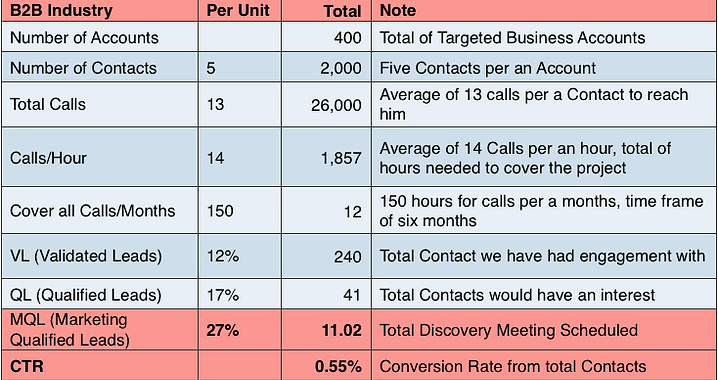
Over the last few years, we have worked with many B2B High-Tech and Enterprise Solution Companies, some are very sophisticated technology. In a traditional industry, we found that an average of 17 calls needed to be made to ‘catch’ the Contact over the phone. The Inside Sales team has about 45 seconds to find the Trigger Point. About 15% of the Contacts will share enough information on the first call and would ask for further details; therefore, they will convert to QL (Qualified Lead) in the sales funnel.
Moreover, 8%, would schedule a Discovery Meeting and will be converted to an MQL (Marketing Qualified Leads) being defined as an opportunity.
An engaging conversion from MQL to SQL (Sales Qualified Leads) can reach to about 22%, based on the assumption that our Inside sales can make about 12-14 calls per hour.
We need to take into consideration that every Account (Targeted Company) would require an average of six Contacts to approach, and sometimes even much more than that.With those figures, we can analyze our expectation and build the forecasting for how many Contacts we must generate and engage through cold calling to create engagement and achieve the MQL stage.
How to calculate the Outbound Marketing CTR and the total Accounts and Contacts your Lead generation would need to validate to achieve the goals:
Inbound Marketing
Having said that, the two variable which are defined the main differences between the marketing channels is: Time and Cost.
THE Fastest Route
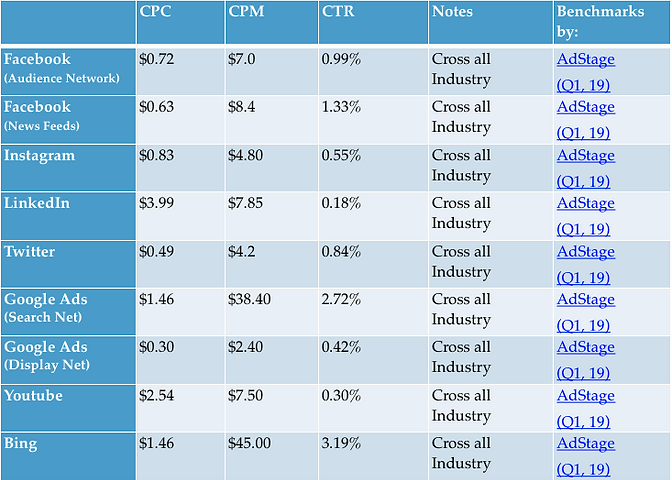
Here are Paid Ads across all Industries Performance, as for Q1, 2019, by Adstage
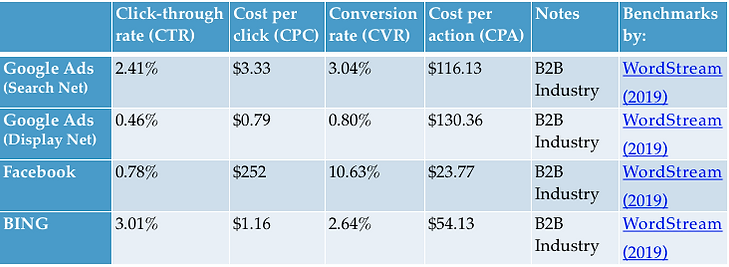
Other platforms can be higher or lower depending on the industry and should be analyzed before making any decision to choose the channel.
THE Budgetary Route
The different paths of the demand generation (paid ads/PPC) tactics are search, social engine, and website optimization. Using these you can know your budget in advance and sometimes even forecast the ROI.
With the budgetary route, you must be patient, even though the results depend on the type of product, industry, and keywords. In the best-case scenario, you will see results within nine months. Hence, patience can pay off, to be among the first 3-10 results can achieve more than 30% of all clicks for a search query conducted.
SEO (Search Engine Optimization) and SMO (Social Media Optimization) include multiple tasks and tactics which need to be taken care of by a professional team and monitored in real-time.
Actions such as keyword optimization, landing page linkage, building/fixing links, and backlink creation are only a few tactics and tasks which should be managed to see results.
As marketers, our goal is to create inbound leads. Hence, your team or agency will need to achieve a few milestones in the process until your SEO and SMO become your inbound lead generation machine.
THE Alternate Route
This route is all about email automation campaigns; a sequence of emails we direct to a group of contacts and in an interval time to provide the reader a trigger to click/download/fill out a form or any response to our messages.
It’s important to understand that the email sequence differs from the direct emails we utilize on the Outbound Marketing.
One of the significant advantages of this route is to scale-up the emails’ personalization and the message to the specific Contact.
However, to get the best benefits from email automation, marketers must invest time to craft the messages, define the purpose of the sequence (such as build the trust, create awareness, relationship, answer to pain point) and structure the A/B test and the email sequence. Besides, the marketing team needs to create and adjust the landing pages, classify and manage the lead generation team.
Compare to the other two routes, the cost in this route can be cheap and except the platform which can cost from $15/month to $800/month, all the rest is the time of the team.
As the other route takes time, in this case, it will happen again; it takes time to create your audience and build an email relationship with them
An average conversion rate in which we combine the new set of Contacts and old Contact list can achieve about 0.5% engagement rate.
A variety of tasks can help to improve the engagement rate and the ROI
- Generate new leads on a weekly base;
- Update, consolidate, and validate old opportunities and connections;
- Generate more Contacts for an old Account;
- Create multiple emails and adjust the messages per purpose;
- Monitor and react for any click, view, or download by one of the Contacts.
Don’t forget! You never know which message will trigger the Contact to engage with your team and cover to QL (Qualified Lead).
Analyze your Inbound Costs
The cost may be changing, depending on the number of MQLs and SQL we are targeting, and especially on variables, such as total contacts, total engagements, number of Accounts and their size, and Contact Position. However, for a small-mid High-Tech company in the US, it can cost from a few hundred dollars per month to tens of thousands of dollars per month.
Choosing the Marketing Automation Platform (MAP) is one of the critical steps to build the Inbound or your Outbound operation. It will design how much of the work will need to be in advance and then the AI and BI system will be more in practice, or the action will fall on the team to update and adjust.
However, before choosing any MAP to achieve a better conversion rate and ROI with Inbound Marketing, analyze the conversion rate per your industry, targeted clients and budget. Upon choosing the Route(s), then select the channel(s) and then the tactics.
The Inbound Marketing method is a more complex orchestra compared to Outbound, in which upon classifying the targeted leads, it’s only a matter of script adjustments, contact validation, and time to get results.
However, are we looking for the right path to improve our performance and get a better ROI or looking at the natural and common way?
IT TAKES TIME
Unfortunately, yes, everything in marketing takes time, and executives usually will think it’s an excuse for a non-result. However, in reality, marketing tactics is not 0 or 1, you must test, try, and be able to change and adjust in real-time until you find the right path in which brings the best results.
One shot or a few weeks is not a time for testing, a minimum time frame to analyze your tactics and operation is 3-4 months and a reasonable time frame is about 6-8 months. It doesn’t mean you must sit aside and wait for the due date; there are many milestones and checkpoints you can verify that you are heading the right direction to generate engagements and the correct path on the Funnel to closing deals.
How will the time factor affect each Route?
Outbound Marketing tactics: In general, about 20% of those the inside sales will reach will ask your Inside sales to call them in a few weeks/month(s), this converts those Leads to VL (Validated Leads). However, it will take time until you can transform into a QL or even MQL, this being the Inside Sales goal.
Inbound Marketing tactics: Yes, with the Paid Ads, Demand Generation, and Email Automation, it might be super-fast, and you can get few inquiries in a few days. However, to build the machine that will work for you in automatic mode, your team must adjust the messages and the keyword.
Summary
In both of the methods, Inbound and Outbound, we are looking for Marketing Iteration. Our primary goal is to build the machine that will work for our sales team in automatic mode to close deals, and our marketing team will have more time to focus, recreate messages and the strategy and as a whole to improve results, achieve goals and beyond.
Inbound or Outbound Marketing tactics are super crucial for the business to generate new engagements on a daily and weekly basis to increase sales. Forecasting your results based on industry conversion rates, your budget, your Sales team’s needs and choose wisely the right direction for your organization, create milestones to the process and monitor it in real-time, change and adjust accordingly.
Empower your brand through Inbound marketing to Build the Revenue Machine
Your Inbound Marketing Machine is our mission, with the ABM Strategy as the route, Digital as our tactics with Marketing Automation Platforms (MAPs) as the vehicle we generate engagements and build the machine to rocket your revenue.
THE RiCH.agency (former name: Fruition Business Group) has worked with clients from all over the globe closely.
We are achievers! Believe that in the marketing tactics today, you have to have full stack of capabilities with BI (Business Intelligence), AI (Artificial Intelligence), digital marketing platforms, and monitoring systems to create engagements, infrastructure the nurture and rotation, facilitate the relationships and the reputation with your B2B Contacts, Buyer Groups, and Accounts.

About the Author
Mr. Kiefer Hazaz who has a 20+ year career, encompasses all aspects of Sales operation, Marketing strategy, Product management, Business development, and C-Level experience, from a variety of High-Tech Companies size and industries.
The vast expertise has provided Mr. Hazaz the potential to maximize Marketing ROI and increase sales through successful ABM Implementations and Marketing Automation Integrations for companies all over the world.